How to Help Your Child Talk, Without Expensive Apps

By Dr Nisa Khalil, Consultant Paediatrician with a special interest in child development, ParkCity Medical Centre (PMC), Kuala Lumpur
Medically reviewed by Dr Nisa Khalil
Last reviewed: August 2026
"Nak anak cepat cakap?" It is one of the questions I hear most, and it usually comes with a phone full of flashcard apps and a shopping cart of educational toys. I understand the instinct completely. When you are worried your child is slow to talk, you want to buy the thing that fixes it.
I am Dr Nisa Khalil, a consultant paediatrician with a special interest in child development, and I sit with anxious parents on this exact topic every week in clinic at ParkCity Medical Centre. So let me save you some money and some worry. The tool with the best evidence for building your child's language is not an app. It is you, and it is free.
Here is how it works, what the science actually says, and the one line I never let a parent forget: this is how you give language the best chance to grow, but it is not a treatment, and it is never a reason to wait if something feels wrong.
The 30-second version
Talk with your child, not at them. The magic is in the back-and-forth, called serve and return.
Say something, then stop. Leave a gap and let your child take a turn, even if the turn is just a babble, a look, or a point.
Follow what they are interested in. Name it, then add one word to whatever they say.
Skip the flashcards and apps. Young children learn language from a responsive person, not a screen. Video-calling Tok and Nenek is fine, that is a real conversation.
Read together every day, and talk about the pictures rather than just reading the words.
This builds language. It does not replace an assessment. If your child is losing words they used to have, or is well behind on the milestones below, get them checked. Do not wait it out.
Now the longer, calmer version.
Serve and return: the free method with the best evidence
Picture a game of pingpong, but with words. Your child serves. They babble, they point at the cat, they hold up a spoon, they look at you. You return the serve. You respond with words, with eye contact, with a name for the thing they are looking at. Then you wait, and let them serve again.
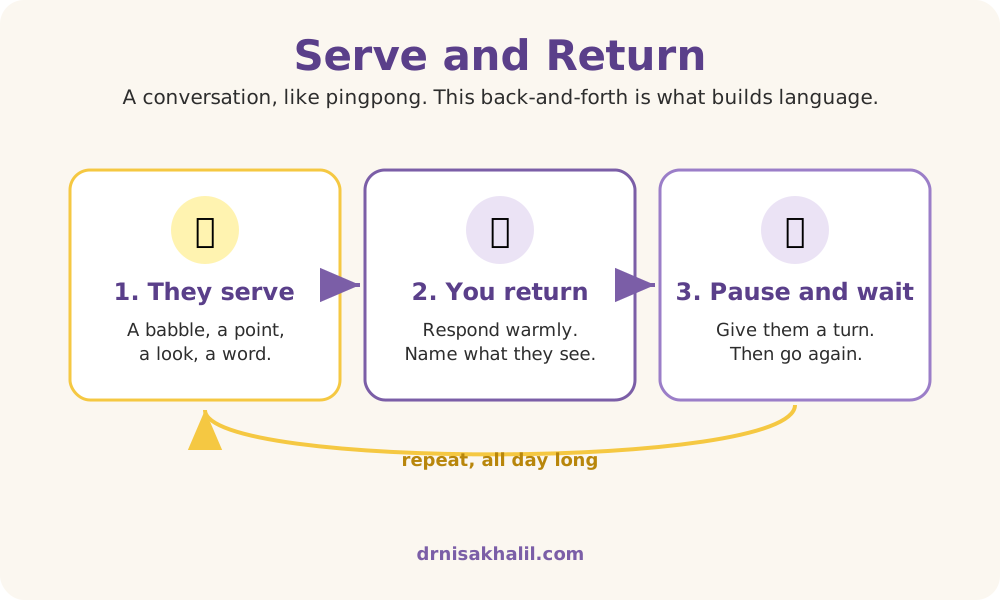
This back-and-forth has a name. Researchers at the Center on the Developing Child at Harvard University call it serve and return, and it is one of the most important things happening in a young child's brain. Every time you notice your child's cue and respond to it warmly, you are helping build the brain connections that language, thinking, and emotion are made of.
Harvard breaks it into five simple moves:
Notice the serve and share your child's focus. Look at what they are looking at.
Return it with warmth, a smile, a nod, a word.
Name it. "Kucing! You see the kucing."
Take turns, and wait. Give them space to respond before you jump in again.
Practise beginnings and endings. Follow their lead when they start something, and when they move on, move with them.
None of this needs equipment. It happens at the sink, in the car, during mandi, over breakfast. The World Health Organization and UNICEF built an entire early-childhood framework around this idea, calling it responsive caregiving, and named it one of the five things every young child needs to thrive.
It is the turns, not the word count
Here is the part most parents miss, and it is the one that takes the pressure off.
You do not need to flood your child with words. A well-known 2018 brain-imaging study from researchers at MIT and Harvard found that it was the number of conversational turns, the back-and-forth, that tracked most closely with children's language ability and with activity in the language centres of the brain. The turn-taking mattered more than the sheer number of words an adult said.
Read that again, because it is freeing. It is not about talking non-stop at your child until you lose your voice. It is about the exchange. A quiet parent who pauses and lets their child reply is doing more for language than a chatty one who never leaves a gap.
I will say the honest caveat too, because I always do. This is an association. Children who get more back-and-forth conversation tend to show stronger language, and there is a very plausible reason why. It does not mean turns alone build a child's whole vocabulary, and it does not mean a child who talks late simply needed more chatting. Keep that in mind as we go.
Five things to actually do, today
These are the strategies speech-language therapists teach parents. You do not need a referral to start them tonight.
What to do | How it works | In real life |
|---|---|---|
Follow their lead | Talk about what your child is already interested in, instead of steering them to what you think they should learn. Observe, wait, and listen. | They are staring at the drain. You talk about the water going down, not the alphabet flashcard in your bag. |
Narrate | Describe what you are doing (self-talk) and what they are doing (parallel talk). It feeds language into ordinary moments. | "Mummy is cutting the carrot." "You are stirring the bubur." |
Expand and recast | When they say a word or part of one, say it back correctly and add one word. No correcting, no shaming. | They say "nak". You say "Nak susu? Okay, susu." |
Pause and wait | Say something, then stop, look expectant, and count to five in your head. Give them room to take a turn. | The waiting feels awkward. Do it anyway. That silence is where they learn it is their turn. |
Read together | Read with them, not at them. Follow their pointing, ask questions, talk about the pictures. | "Where is the bunny? Yes! What is the bunny doing?" |
The thread running through all five is the same: warm, responsive, back-and-forth. Reading together, in particular, has good evidence behind it for building vocabulary, though the size of the benefit varies from child to child, so I would call it a wonderful habit rather than a guarantee.
Why the apps and flashcards are not the answer
I am not anti-technology, and I am not here to make you feel guilty about the tablet. But you deserve to know what the research actually shows, because it is clear and it is useful.
Young children learn far less from a screen than from the same thing delivered by a responsive person. Scientists call it the video deficit. In classic experiments, toddlers learned a new word from a real person who responded to them, but not from a video of the same person saying the same word. The difference is the response. A screen cannot notice your child's serve and return it.
That is why the guidance from the major bodies is what it is:
The American Academy of Pediatrics advises avoiding screen media under 18 months, other than video-chatting, and co-viewing with your child from 18 to 24 months.
The World Health Organization advises against screen time for children under 2 (it is not recommended for infants or one-year-olds), and no more than an hour a day from ages 2 to 4, less being better.
Notice the one exception both allow: video-calling a real person. Facetiming Tok and Nenek is genuinely interactive, so it does not carry the same deficit. That is a real conversation, just through a screen.
And flashcards and "teach your baby to read" apps? There is simply no good evidence that they build spoken language better than ordinary, everyday talk. Language is learned through meaningful, social, back-and-forth exchange, not drill. So the honest bottom line is not that screens are evil. It is that the thing a screen tends to replace, turns of live conversation with you, is the very thing that grows language. Your face and your voice are the app with the best evidence. (More on healthy screen habits in my guide to screen time for babies and toddlers.)
But talking more is not a treatment
I have to be very clear here, because this is where good intentions can go wrong.
Everything above gives your child the best environment for language to grow. It is not a treatment, and it does not fix or prevent a speech delay. Language delay has many causes, hearing problems, developmental differences, and others, and no amount of talking at home overrides them.
So please hold two things at once. Fill your child's days with warm back-and-forth talk, because it genuinely helps. And if you are worried, get your child assessed anyway, without waiting to see if more talking sorts it out. "Just talk to them more" is good advice for building language. It is bad advice as a reason to delay help for a child who might need it.
One more thing I check before anything else: hearing. A child who cannot hear well cannot learn to talk well. If speech is a concern, a hearing check comes first, every time.
Two languages at home does not cause speech delay
This one comes up in almost every Malaysian family, so let me settle it plainly.
Raising your child with Malay, English, Mandarin, Tamil, and a dialect or two does not cause a speech delay, and it does not make one worse. Bilingual and multilingual children reach the core language milestones in the same normal range as everyone else. This is the firm consensus of speech and paediatric bodies worldwide.
Two things worth knowing:
Count both languages together. Your child might know fewer words in Malay alone than a monolingual child, but their total vocabulary across all their languages is usually equal or greater. Judging them on one language makes a perfectly normal child look behind.
Mixing languages in one sentence is normal. Rojak-ing Malay and English mid-sentence is ordinary bilingual behaviour, not confusion.
But here is the boundary again, because it matters. Bilingualism does not cause a delay, and it also does not explain one away. If your child shows the red flags below, "it is because we speak two languages" is not a safe reason to wait. A genuine language difficulty shows up across all of a child's languages, not just one.
What is typical, and by when
Milestones are not a race or a report card. They describe what most children can do by a certain age, and they exist so that we notice early if a child might need support. A child a little behind on one is a reason to keep an eye and ask, not to panic.
Here is the current communication guide from the CDC's Learn the Signs programme, developed with the American Academy of Pediatrics.
Age | Most children can... |
|---|---|
12 months | Wave bye-bye. Call a parent "mama" or "dada" or a special name. Understand "no". |
15 months | Try to say one or two words besides "mama" and "dada". Point to ask for something. |
18 months | Try to say three or more words besides "mama" and "dada". Follow a one-step instruction without a gesture. |
2 years | Put at least two words together, like "more milk". Point to things in a book when you ask. |
2.5 years (30 months) | Say about 50 words. Say two or more words together with an action word, like "doggie run". |
Source: CDC Learn the Signs. Act Early. (milestones updated 2022, developed with the AAP).
You may see 50 words given at 2 years in some guides and at 2.5 years in others. They measure different things. The CDC lists the age by which about 3 in 4 children get there, so its number comes later. Speech therapists (ASHA) use the earlier mark, fewer than 50 words or no two-word phrases at 2, as the point to get a check. I use the earlier one, because waiting is the part that costs time.
Read these as guides, not verdicts. They were set at the age most children reach them, so missing one is a prompt to check in with your doctor or Klinik Kesihatan, not an automatic diagnosis. For a fuller picture across all areas of development, see my guide on how to tell if your child is developing normally.
When to stop waiting and get an assessment
Milestones tell you what is typical. These are the signs that mean book an assessment now, rather than wait and hope. I am not listing them to frighten you. I am listing them because early help works best when it starts early, and access here can take time, so waiting has a real cost.
The most important one, first. If your child is losing words, babble, gestures, or social skills they used to have, at any age, that needs a prompt review. Not next month. This is the sign I take most seriously, and "boys just talk late" is never the answer to it.
Also get your child seen if:
No babbling and no gestures, like pointing or waving, by around 12 months
No single words by around 16 months
Fewer than 50 words, or no two-word phrases, by around 2 years (copied or echoed speech does not count)
Not responding to their name, or little eye contact, by the expected age
You, the parent, often cannot understand your child's speech for their age
Any sense that your child may not be hearing well. Always check hearing first.
These signs mean it is worth getting your child checked. They are not a diagnosis, and many children who show one turn out completely fine. But the safest thing is always to assess early, especially with any loss of skills. For the fuller version, see my guide to the signs of speech delay and when to see a doctor.
Worried about your child's talking? If your child is missing the milestones above, losing words, or something just feels off, please do not wait it out. An early assessment is never an overreaction. Come and see me at ParkCity Medical Centre and we will work through it together, calmly, and check hearing while we are at it. Book here: drnisakhalil.com/appointment 💜
Where to get help in Malaysia
Your first stop is your Klinik Kesihatan. The nurse or medical officer can do a developmental check and refer your child on where needed, to speech-language therapy, an early intervention programme, or a paediatrician. Private paediatric and speech-therapy services are the other route, often faster.
I will be honest about the system, because it changes what I advise. Developmental screening in Malaysia is strongest in infancy, tied to the vaccination visits, and thins out for the two to six year olds, exactly the age speech concerns often surface. Therapy places can have waitlists. That is precisely why I do not tell worried parents to "wait and see". Getting into the queue early is part of getting help early. Bring your child's Buku Rekod Kesihatan to every visit, and raise the concern out loud, even if it feels small.
Myth vs fact
You may hear | What the evidence says |
|---|---|
"Buy the flashcard app, it will teach him to talk." | No good evidence apps or flashcards beat everyday back-and-forth talk. Live, responsive conversation is what builds language. |
"Speaking two languages at home makes children talk late." | It does not. Bilingual children hit milestones in the normal range. Count their words across all languages. |
"Boys just talk late, give it time." | Sometimes a late talker catches up. But losing skills, or being well behind, is never something to wait out. Get it checked. |
"He understands everything, so his speech is fine." | Good understanding is reassuring, but not a reason to ignore very delayed talking. Assess if you are unsure. |
"Just talk to him more and he will be okay." | Talking more helps every child. It is not a treatment, and not a reason to delay an assessment for a child who may need one. |
Frequently asked questions
What is "serve and return" and how do I do it?
Serve and return is the back-and-forth between you and your child, like a rally in pingpong. Your child "serves" with a babble, a look, a point, or a word. You "return" it by responding warmly, naming what they are focused on, then pausing to let them take another turn. You can do it anywhere, during meals, bath time, or in the car. This responsive back-and-forth is one of the most evidence-based ways to support your child's language, and it costs nothing.
How can I help my toddler talk more at home, without apps?
Follow your child's lead and talk about what they are interested in, narrate what you and they are doing, repeat their words back and add one more ("car" becomes "red car"), pause to give them a turn, and read together every day while talking about the pictures. These are the same strategies speech therapists teach parents. Live, responsive conversation builds language far better than any app or flashcard.
Is screen time bad for my baby's speech?
Young children learn less from a screen than from a responsive person, a pattern researchers call the video deficit. Major bodies advise avoiding screen media under 18 months (other than video-calls) and limiting it after that. The exception is video-calling a real person, which is genuinely interactive. The concern is less that screens are harmful and more that they replace the back-and-forth talk that grows language.
My 2-year-old is not putting two words together. Should I be worried?
Putting at least two words together, like "more milk", is a milestone most children reach by 2 years, so it is worth raising with your doctor or Klinik Kesihatan if your child is not doing it yet. It is not an automatic diagnosis, and some children catch up, but it is a reason to check rather than wait, especially if there are other concerns or any loss of skills. Have their hearing checked too.
Does raising my child bilingual cause speech delay?
No. Speaking two or more languages at home does not cause or worsen speech delay, and bilingual children reach language milestones in the normal range. Count your child's words across all their languages, not just one. Mixing languages in a sentence is normal. Bilingualism is also not a reason to delay an assessment, though. A genuine difficulty shows up across all of a child's languages.
My child said a few words and then stopped. Is that normal?
Losing words, babble, gestures, or social skills that your child previously had is the one sign I never wait on, at any age. It always deserves a prompt assessment. Please do not let anyone tell you to give it time. Book a review with your paediatrician or Klinik Kesihatan, and mention exactly which skills your child has lost.
When should I see a doctor about my child's speech?
See a doctor if your child loses skills they had, has no babbling or gestures by around 12 months, no words by around 16 months, fewer than 50 words or no two-word phrases by around 2 years, does not respond to their name, or if you suspect a hearing problem. These are prompts to assess, not diagnoses. Early help works best when it starts early, so it is always better to check than to wait.
Where do I get my child's speech assessed in Malaysia?
Start at your Klinik Kesihatan, where a developmental check can lead to a referral for speech-language therapy, an early intervention programme, or a paediatrician. Private paediatric and speech-therapy services are the other option and are often quicker. Because waitlists exist, it is best to raise the concern early rather than wait and see.
Key takeaways
The best tool for your child's language is you. Warm, back-and-forth talk beats any app.
It is the turns, not the word count. Say something, then pause and let your child reply.
Follow their lead, narrate, expand, wait, and read together. Five free habits, starting tonight.
Screens teach language poorly, apart from video-calling a real person. Flashcards and apps are not the shortcut they promise.
This supports language. It is not a treatment. If you are worried, get an assessment, and check hearing first.
Two languages at home is not the problem, and never the reason to delay help.
Loss of skills at any age is the red flag that always needs a prompt review.
If something feels off, trust it. You know your child better than any chart. If your gut says their talking is not coming along the way it should, that is reason enough to come in. Earlier is always easier than later. Book an appointment: drnisakhalil.com/appointment 💜
About the author
Dr Nisa Khalil is a consultant paediatrician with a special interest in child development, practising at ParkCity Medical Centre in Kuala Lumpur. She is known for a calm, evidence-based approach and for helping Malaysian parents feel more confident and less anxious in the early years. Follow her on Instagram at @drnisakhalil or book a consultation at drnisakhalil.com/appointment.
Medically reviewed by: Dr Nisa Khalil, Consultant Paediatrician (ParkCity Medical Centre, Kuala Lumpur). Last reviewed: August 2026. Scheduled for review by August 2027, or sooner if guidance changes.
Disclaimer: This article is for general educational purposes only. It does not replace an individual assessment or the advice of a qualified healthcare professional. Every child is different. If you have concerns about your child's speech, language, hearing, or development, please see your paediatrician or nearest clinic.
References
Center on the Developing Child, Harvard University. Serve and Return, and 5 Steps for Brain-Building Serve and Return. https://developingchild.harvard.edu/key-concept/serve-and-return/
Romeo RR, et al. Beyond the 30-Million-Word Gap: Children's Conversational Exposure Is Associated With Language-Related Brain Function. Psychological Science, 2018.
World Health Organization, UNICEF, World Bank. Nurturing Care for Early Childhood Development. 2018. https://nurturing-care.org/
American Academy of Pediatrics, Council on Early Childhood. Literacy Promotion: An Essential Component of Primary Care Pediatric Practice. Pediatrics, 2014.
American Academy of Pediatrics, Council on Communications and Media. Media and Young Minds. Pediatrics, 2016. https://publications.aap.org/pediatrics/article/138/5/e20162591/60503/
World Health Organization. Guidelines on physical activity, sedentary behaviour and sleep for children under 5 years of age. 2019. https://www.who.int/publications/i/item/9789241550536
American Speech-Language-Hearing Association (ASHA). Activities to encourage speech and language development, and Late Language Emergence practice portal. https://www.asha.org
The Hanen Centre. Observe, Wait and Listen (OWL) and The Power of Waiting. https://www.hanen.org
Centers for Disease Control and Prevention. Learn the Signs. Act Early. developmental milestones (updated 2022; Zubler J, et al. Pediatrics, 2022). https://www.cdc.gov/act-early/milestones/index.html
Worried about your child?
Book an appointment with Dr Nisa Khalil for calm, evidence-based paediatric care when your child is unwell.
Book an appointment